
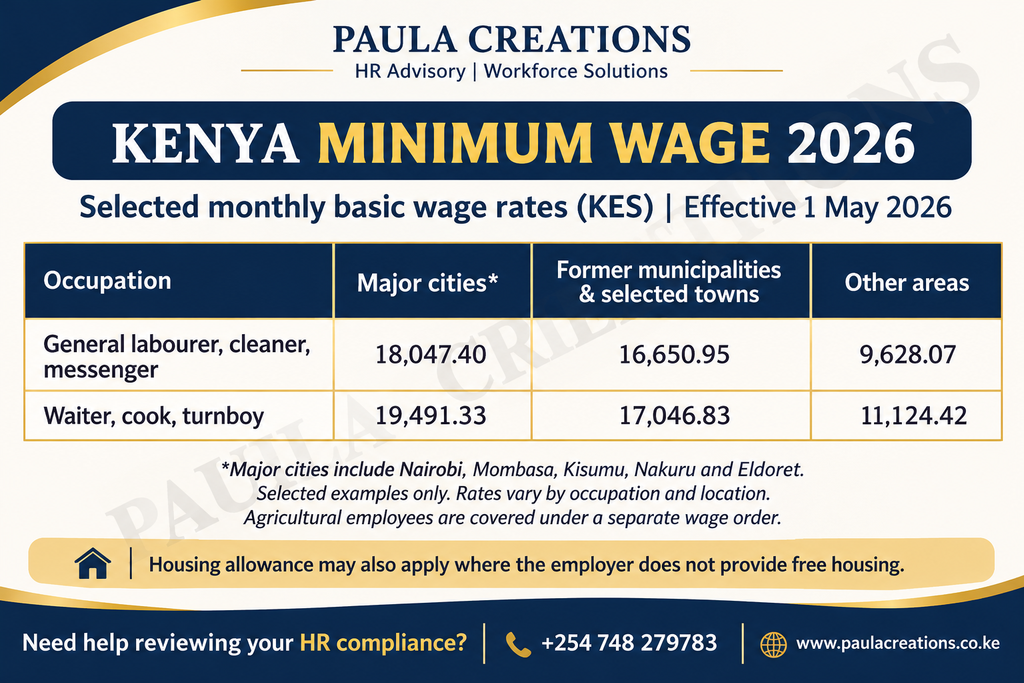
Kenya’s minimum wage requirements changed with effect from 1 May 2026, following the issuance of the Regulation of Wages (General) (Amendment) Order, 2026.
For employers, this is an important reminder that paying employees is not just about agreeing on a salary. Businesses must ensure that their pay structures comply with the applicable minimum wage, occupation classifications and other statutory employment requirements.
At Paula Creations, we encourage businesses to review their employment and payroll practices regularly to avoid compliance gaps that could expose them to unnecessary employee disputes and legal risks.
1. What are the 2026 minimum wage requirements?
The 2026 wage order provides different minimum rates depending on an employee’s occupation and geographical location.
For example, the monthly minimum basic wages for selected occupations are:
| Occupation | Major cities* | Former municipalities and selected towns | Other areas |
|---|---|---|---|
| General labourer, cleaner, messenger | KES 18,047.40 | KES 16,650.95 | KES 9,628.07 |
| Waiter, cook, turnboy | KES 19,491.33 | KES 17,046.83 | KES 11,124.42 |
Major cities include Nairobi, Mombasa, Kisumu, Nakuru and Eldoret.
These are selected examples, not the complete wage schedule. Employers should identify the correct occupational category and applicable geographical zone before determining the minimum payable wage.
Agricultural employees are covered under a separate wage order, with different rates.
2. Do not overlook housing allowance
One important consideration for employers is housing allowance.
For monthly-paid employees, the minimum wage figures are exclusive of housing allowance. Where an employer does not provide free housing, a housing allowance of at least 15% of the basic wage is applicable, unless another lawful arrangement applies.
This means that simply paying the gazetted basic minimum wage may not be sufficient to meet the employer’s obligations.
Employers should review how basic pay and housing allowance are structured and reflected in employment contracts and payroll records.
3. What should employers do now?
Minimum wage compliance should be part of routine HR and payroll management.
We recommend that businesses take the following steps:
- Review salary structures: Compare current basic salaries against the applicable 2026 minimum wage rates.
- Verify job classifications: Ensure employees are categorised correctly according to their actual occupations.
- Review employment contracts: Confirm that salary terms and housing allowance provisions are properly documented.
- Audit payroll: Check that payroll calculations, statutory deductions and employee records are accurate.
- Address any gaps: Make the necessary salary adjustments and update relevant employment documentation.
Remember, compliance is not a once-off exercise. Businesses should continue monitoring changes in employment legislation and reviewing their HR practices accordingly.
4. Is your business HR compliant?
As businesses grow, managing employment contracts, payroll, statutory obligations and employee relations becomes increasingly important.
However, many SMEs operate without a dedicated HR department or the internal expertise needed to keep up with changing employment requirements.
This is where professional HR support makes a difference.
Paula Creations supports businesses with practical HR Advisory and Compliance services, helping employers establish sound HR structures, review employment practices, manage employee documentation and strengthen their people operations.
Whether you are employing your first few employees or managing a growing workforce, getting your HR foundations right protects your business and supports sustainable growth.
Need help reviewing your HR compliance?
Speak to Paula Creations. Let us help you identify gaps, strengthen your HR processes and manage your workforce with confidence.
Paula Creations Limited
Your practical HR partner for growing businesses | Contact us to discuss your HR Advisory and Compliance needs.